
Describing language proficiency
The Common European Framework of Reference (CEFR) is the predominant language proficiency framework used in the field of English as a Foreign Language (EFL)/English as a Second Language (ESL). The CEFR was published in 2001 by the Council of Europe. It describes language learners’ ability in European languages, including English, using scientifically validated ‘can do’ descriptors associated with the four skills of Listening, Speaking, Reading, and Writing. The CEFR is considered the international standard in language teaching and learning (British Council & Eaquals, 2015, p. 7).
The CEFR levels are:
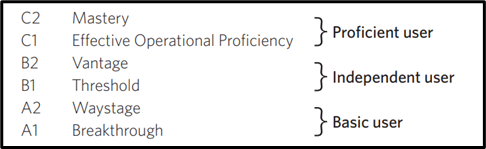
Figure 1: The CEFR Levels (University of Cambridge ESOL Examinations, 2011, p. 4)
The CEFR uses ‘can do’ descriptors focusing on what learners are capable of, rather than what they lack or get wrong. For example, the overall written production descriptors present ‘can do’ statements about a learner’s overall writing ability.
In the category of overall written production, for example, at B2 the learner ‘Can write clear, detailed texts on a variety of subjects related to his/her field of interest, synthesising and evaluating information and arguments from a number of sources’ (Council of Europe, 2018, p. 75). Notice that the absolute beginner (A0 or Pre-A1) is not on the CEFR scale. This is because the level is so low and varies so much between speakers that it cannot be meaningfully or systematically described. The CEFR also features a global scale, which is shown below.
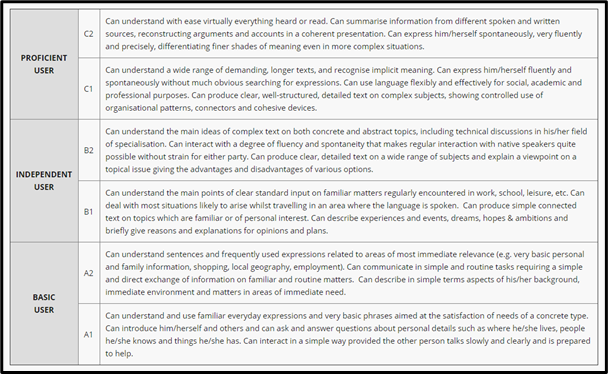
EFL/ESL courses are frequently named according to their level and coursebooks targeted to those levels are used. The image below shows a common way to structure language courses based on levels found in most EFL/ESL textbook series.
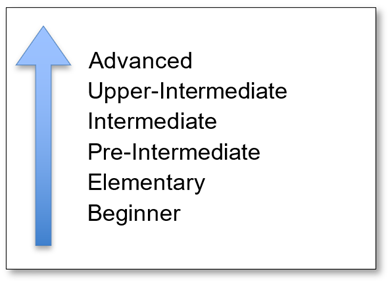
Figure 3: Language Levels. Adapted from Scrivener (2011, p. 87)
Curriculum is often planned according to how long each level should take an average student to complete. In some university courses, each level from Elementary through to Advanced Plus is presumed to take 200 hours (20 hours per week for 10 weeks) to complete (Source: RMIT University, 2020).
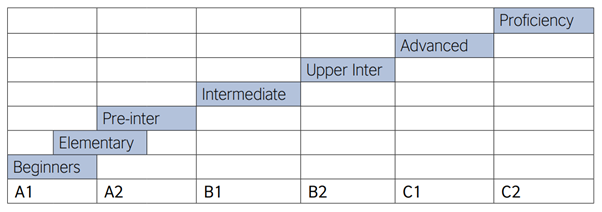
Language course and language level names such as ‘beginner’ or ‘intermediate’ are not always used consistently across different contexts. As such, the CEFR provides a more accurate method of describing the different language levels (British Council & Eaquals, 2015, p. 7). The graphic below shows commonly used language level labels and their correlation with the CEFR levels. It demonstrates that the correlation of commonly used level names with CEFR levels at lower levels is not perfectly accurate, but the correlation becomes closer at higher levels.
The CEFR provides a good starting point for curriculum development (British Council & Eaquals, 2015, p. 7). Additionally, even though the CEFR is not actually an assessment tool, its descriptor scales can be used in developing assessments (Council of Europe, 2018, p. 41). Major standardized language proficiency tests such as the Cambridge English Qualifications and Cambridge IELTS (International English Language Testing System) are often correlated with CEFR levels as shown in the following graphic.
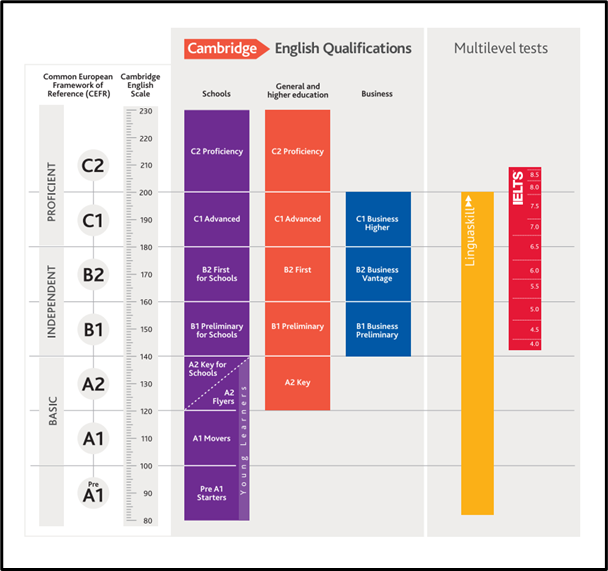
Since its publication, the CEFR has been influential around the world and has helped in needs analysis, curriculum development, assessment development, language policy development and teacher training courses. Standardized tests and mainstream English language textbooks refer to CEFR levels, giving practitioners ‘a common language to describe proficiency levels’ (Berry & O’Sullivan, 2020, p. 2).