
Differentiation – seeing students as individuals
Traditional teaching styles were characterized by a ‘one size fits all’ approach. In contrast, differentiation involves identifying individual differences between students and taking these into account in the classroom to ensure that all the students learn as effectively as possible.
Children can differ in terms of age and / or maturity, strengths and weaknesses in English, personality, and interests as well as motivation and learning preferences. Teachers need to appreciate these differences.
Motivation
Adult ESL learners are often ‘extrinsically motivated’, which means that their motivation to learn English comes from outside the classroom. Perhaps they need to improve their English for work, or they want to be able to help their children with their homework. In contrast, children are ‘intrinsically motivated.’ Their motivation is generated by what happens inside the classroom – so it is up to teachers to try and ensure that their lessons are as engaging as possible.
First, make sure that the topics and materials that you use in the classroom are likely to be interesting for children of their age and backgrounds. Consider their level of English and choose activities that are reasonably challenging but ‘do-able’ – it’s important that children are stimulated but not overwhelmed. As we saw in Module 2, oral tasks need to be as communicative as possible, so that students have a real reason to speak.
The younger the children are, the shorter their attention spans are likely to be, so don’t let activities go on too long and incorporate plenty of variety. It’s a good idea to vary the interaction patterns as well as the activities. Include a mixture of ‘whole class’, pair work and group work activities and don’t forget to have extra tasks up your sleeve for ‘fast finishers.’
Pay careful attention to the way you set up tasks, as students can quickly become demotivated if they are not sure what to do. Check any grammar or vocabulary that your students will need to know in order to complete a task successfully. Remember to demonstrate tasks consistently so that students can see how they work. Then, while the children are working on the activity, monitor and offer encouragement and praise.
Learning preferences
VAK learning preferences and Gardner’s theory of multiple intelligences are two ways of analysing the differences between individual students.
VAK learning preferences
The idea behind the VAK learning preferences model is that we all have a preferred way of learning. We are all predominantly either visual, auditory or kinesthetic learners.
Visual learners take in new information most easily when they see it. People who prefer to learn in this way respond well to images, drawings and color-coded material. Auditory learners learn information best when they have the opportunity to listen to it. An auditory-dominant learner absorbs information best from a lecture or a group discussion. Finally, kinesthetic learners find it easiest to learn when they are engaged in physical touch or movement. In the language classroom, sorting or ordering cards or participating in roleplays can help these students learn.
There is a lack of evidence showing that students learn better if the training they receive is geared towards one particular learning preference. However, this model has proven to be very popular with educators and many teachers take students’ VAK learning preferences into account when they are planning their lessons.
Theory of Multiple Intelligences
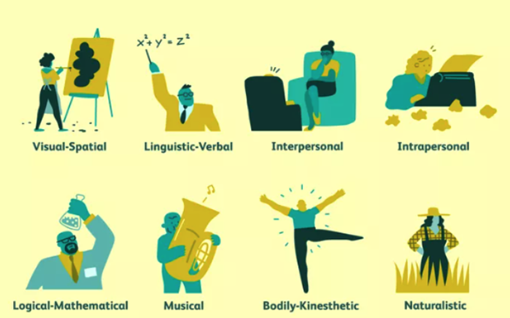
Harvard psychologist Howard Gardner proposed the theory of multiple intelligences. Gardner theorized that people do not have just an intellectual capacity, but have many kinds of intelligence.
People with…
- musical intelligence have a strong appreciation for music. They are good at noticing sounds, identifying rhythms and recognizing tunes.
- interpersonal intelligence are good at understanding and interacting with people.
- spatial-visual intelligence are good at interpreting pictures, diagrams and maps.
- linguistic intelligence are good with words and language.
- logical-mathematical intelligence are good at reasoning and analyzing problems.
- bodily-kinesthetic intelligence usually have excellent hand-eye coordination, dexterity and physical control.
- intrapersonal intelligence are able to reflect well on their own strengths and weaknesses.
- naturalistic intelligence are more ‘in tune’ with nature.
As with VAK learning preferences, there is a lack of evidence supporting Gardner’s theory. Critics argue that his eight ‘intelligences’ are simply a combination of talents and personality traits. Despite this, Gardner’s theory of multiple intelligences has gained considerable popularity. The positive outcome of the popularity of these models has been that teachers everywhere are paying more attention to their students as individuals. As we have seen, including a variety of activities is likely to have a positive impact on students’ motivation levels.