
What makes a good language lesson?
Here is an example of a basic outline for a beginner-level language lesson.
Lesson Objectives: By the end of the lesson students will…
- have learned and had opportunities to practice using four items of vocabulary.
- have learned and practiced functional language for ordering an ice cream.
To teach this lesson, the following materials are needed:
- whiteboard and pens
- five large flashcards (ice cream shop, a vanilla / strawberry / chocolate / caramel ice cream)
- sets of small cards showing the four different ice creams (one set per child)
Stage One – Introduce the context
Show the ‘ice cream shop’ flashcard. Ask ‘Where are they?’ (They are at an ice cream shop.) That’s right. They are at an ice cream shop. ‘Do you like ice cream?’ etc.
Stage Two – Teach the vocabulary
Show the flashcards one at a time. Elicit and drill the new vocabulary.
Stage Three – Controlled oral practice (Demonstrate this before handing out the materials.)
Students work in pairs. Each student has four different pictures of the four different ice creams. They put their pictures face down. The first student turns over one of their pictures and says what it is. ‘Strawberry ice cream!’ for example.
The second student turns over one of their pictures and says what both pictures are. ‘A strawberry ice cream and… a vanilla ice cream.’ This continues until all the cards have been used. Repeat the task until all the students can use the vocabulary confidently.
Stage Four – Controlled oral practice (Again – demonstrate this first.)
Put pairs of students together so that you have groups of four. Put all the cards face down in the middle of the table – and mix them up. The first student turns over two cards and says what they are. If they are the same, this student can keep them. If not, this student turns them face down again. Everyone tries to remember where the cards are – and it’s the next person’s turn. This continues until all the cards have been ‘won.’ The winner is the student with the most cards.
Stage Five – Teach the functional language
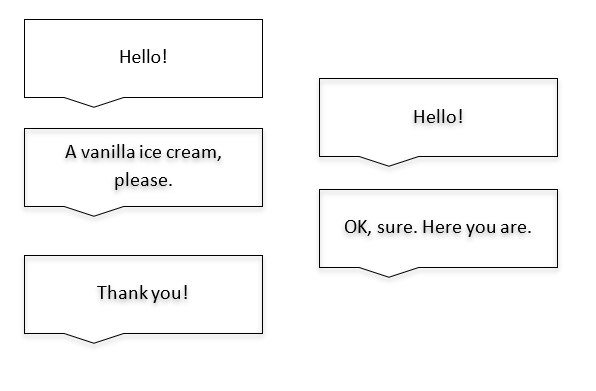
Stick the ice cream shop flashcard on the board. Establish that you are now at the shop and you want to buy an ice cream. Draw speech bubbles on the board like this to help you elicit the conversation. (Make this conversation a bit more challenging if you are confident that your students can handle it.) Rub off the words and ask students to practise again in pairs.
Stage Six – Role play – less controlled oral practice (Again – demonstrate this first.)
Give all the students a letter – ‘A’ or ‘B’. All the A’s are shop assistants. They come and stand in a line. All the B’s are customers. They visit three different ice cream shops and order an ice cream. It’s a good idea to leave the blank speech bubbles on the board to help them get started. Then they change roles and repeat the activity.
All the green stages of the lesson are teacher-centered. With beginner-level classes, the ‘teaching’ stages generally need to be teacher-centered, as the language is likely to be completely new to the students. This is not the case with higher level classes.
All the pink stages of the lesson are student-centered. These are ‘practice’ stages. Asking students to work in pairs or groups is a great way to maximize student talking time.
Checklist: ingredients of a successful lesson
- Is the topic / material appropriate for the children’s age?
- Is the language appropriate for the children’s level?
- Are the activities appropriate for the children’s level?
- Are the steps of the procedure logically ordered?
- Does the lesson cater for a range of VAK learning preferences and/or multiple intelligences?
- Is there a balance between teacher-centered and student-centered stages?
- Is there a balance between ‘whole class’, pair and group work activities?
- Are the practice tasks motivating? Is there a variety?