
Anticipating problems and solutions
When teachers analyze language for teaching purposes, they try to anticipate what aspects of the meaning, form and pronunciation of the target language might cause difficulties for students.
For example, an experienced teacher would predict that students might have difficulty distinguishing between the use of the past perfect and other past tenses such as the past simple and past continuous. They might also anticipate that the form of irregular past participles could be problematic and in terms of pronunciation, the contraction of ‘had’ might be tricky.
A teacher who was preparing to teach the word ‘embarrassed’ might predict potential confusion with ‘ashamed’ if students are already familiar with this word. In terms of form it would be helpful to introduce the collocation ‘be embarrassed about something’ rather than just the adjective. Experienced teachers would also anticipate potential problems with the word stress (stressing the wrong syllable) and the pronunciation of the ‘ed’ ending.
Analysing language thoroughly enables teachers to predict a variety of potential problems so that they can teach more effectively in the classroom. In terms of meaning, potential problems can include collocation (the way in which words are commonly used together), connotation, appropriacy and formality.
When focussing on form, as well as the part of speech, students need to know whether words have any dependent prepositions (such as ‘be embarrassed about something’), whether verbs are regular or irregular, and it is also important for them to learn relevant verb patterns (such as ‘apologize to the teacher for being late’).
Vocabulary Records
Teachers can help students to learn vocabulary more effectively by encouraging them to make their records of new vocabulary as useful as possible. Many teachers advocate the use of English-English dictionaries in the classroom because they are usually an excellent source of information and include plenty of examples of natural use of language.
For example, this vocabulary record:
| apologize (v) – apologize (to sby) for (doing) sthg /əˈpɑːlədʒaɪz/ |
| He apologized to the teacher for being late. He apologized to the teacher. He apologized for being late. |
Provides much more information than a simple translation like this one:
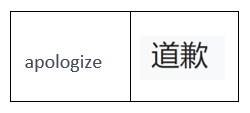
With higher levels, teachers can include more detailed information regarding common phrases or collocations.