
Building up students’ fluency
Freer oral practice helps to bridge the gap between controlled practice tasks and speaking activities which are truly fluency-based. Well-designed freer oral practice tasks give students the chance to use the target language together with any other English they know.
When using freer practice tasks with lower level students, it is important for teachers to think through exactly what their students will need to be able to say, and make sure that they are well-prepared before they start the activity. Students will quickly become demotivated if they don’t know what to do or they don’t have enough language to be able to complete the task successfully.
More advanced students will find it easier to follow instructions and express themselves, but regardless of your students’ level, it is still important to prepare carefully and ‘scaffold’ more complex tasks well so that you set your students up for success.
Key ingredients of successful speaking skills tasks:
a) They provide lots of opportunities for students to speak freely.
b) They have a clear communicative goal.
c) They are motivating, challenging and fun.
Examples of Free Speaking Activities
Most free speaking activities are either personalized tasks, discussions, roleplays, or problem-solving tasks, although many activities fall into more than one category.
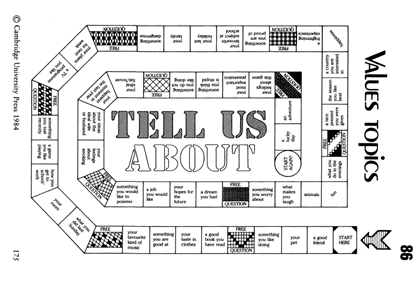
Personalized tasks such as this board game from ‘Keep Talking’ need very little scaffolding, as students are only required to talk about themselves.
Discussions – Walking into the classroom and saying, for example, ‘Today, we’re going to discuss the environment. What do you think?’ is not the most effective way to encourage a lively discussion in an ESL classroom.
Where possible, try to choose topics which are likely to relate to students’ experiences or background knowledge. Alternatively, create interest in an unfamiliar topic by using a reading or listening text first so that students learn more about it. In the case of a discussion about the environment, is there a local issue that might be relevant to your students’ lives?
For example, perhaps there are plans to build a hotel near an area of natural beauty. In this case, you could combine the idea of a discussion with a roleplay.
Half the class could be in favor of the project and the other half of the class could be against. This gives the students a reason to talk. First, students with the same views could work together in small groups to prepare their arguments. Then they could pair with one student who has the opposite point of view and try to convince their partner that they are right. This element of problem solving gives the discussion a clear communicative goal.
Roleplays have a huge amount of potential and adapt well to a wide variety of lessons. For example, they can be a great way to wrap up receptive skills lessons on almost any ‘human interest’ story. If the text was about someone who started their own company, sailed around the world, or won the lottery, the post-listening / reading stage could involve a roleplay with a news reporter interviewing this person.