
Example of a speaking skills lesson
Here is an example of a speaking skills lesson that could be used with pre-intermediate / intermediate students.
1. Lead in – Draw something which looks like this on the board:
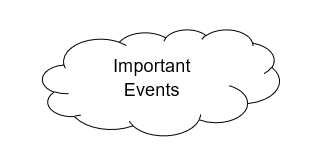
Elicit examples of important events in your students’ lives.
For teenagers, this might include birthday parties, getting a special present, going on holiday, having an accident, passing a test, learning how to do something, getting a pet, buying something…
With adults, you could add buying a car, meeting your partner, graduating from university, finding an apartment, travelling, getting your first job…
2. Preparing to speak
Draw four boxes on the board. In each box, write one sentence about an important event in your life. Include the date when it happened.
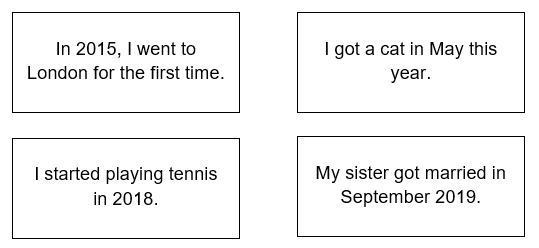
Give each student four post-its and ask them to do the same. On each post-it they should write one sentence about an important event in their lives – and include the date when it happened.
(Check your instructions by asking: How many sentences do you write on each post-it? Do you need to write the date?) Monitor closely to check that students are ‘on task.’
3. Useful language
Encourage students to ask you questions to find out more about your events. Tell the students the answers. Write the questions on the board, as examples of ‘useful language.’
Possible questions:
Why did you go to London? How long did you stay in London?
What’s your cat’s name? What color is he / she?
Why did you start playing tennis? Are you good at it? How often do you play?
Where did your sister get married?
4. Speaking task
Put students into groups of 3 or 4. The students put their post-its together in the middle of the table. Then ask them to organize everybody’s post-its in order – from the oldest to the newest (this is just a way of mixing up the order).
Starting with the oldest post-it, students take it in turns to ask their classmates about their important life events. Each student must ask at least one / two question(s) per post-it.
While students are speaking, monitor unobtrusively and take notes. Listen for: a) interesting stories b) examples of well-formed questions c) mistakes with question forms.
5. Feedback on content
Keep this short. Just ask two or three groups to choose one story which was interesting (or you can do this based on your monitoring) and share it with the class.
6. Feedback on language
Draw something like this on the board with intentional mistakes:
1. Why you went to New York?
2. How much cost your motorbike?
3. What subject did you study at university?
4. How long did you stay in Australia?
5. How often do you play football?
6. What were you do on your birthday?
The idea of this stage is to encourage students to self or peer-correct some of their mistakes. Do an example or two with the class to show the students how it works. Ask students to look at the first sentence and decide whether it is right or wrong. Elicit that it is wrong and elicit the correction onto the board. Do the same with the second sentence if necessary and then ask students to work in pairs and continue with the rest of the sentences. Finally, round off the activity with class feedback.