
External exams – TOEFL, IELTS and Cambridge
When the TOEFL (Test of English as a Foreign Language) first appeared in the 1960s, there were five sections: reading, vocabulary, listening, English structure and grammar. All five sections involved multiple choice questions and, incredible though it seems today, there was no evaluation of students’ speaking or writing skills.
Since then, times have changed. Although a knowledge of grammar and vocabulary is clearly important, asking students to complete indirect, discrete item tests fails to show whether students can actually use this language effectively. For this reason, many internationally recognized proficiency exams have moved more towards direct testing in recent years.
In 2005, the format of the TOEFL finally changed and it now consists of four sections: listening, reading, writing, and speaking, although the speaking test is computer-based and does not involve face-to-face interaction with an examiner.
The IELTS (International English Language Testing System), which was developed during the 1980s, has always had four sections: listening, reading, writing, and speaking. The speaking test takes the form of a face-to-face interview with an examiner, which is recorded.
Cambridge exams such as the B2 First, formerly known as Cambridge English: First (FCE), have also moved towards more direct testing in recent years. The B2 First now consists of four sections: reading and use of English, writing, listening and speaking. The speaking test is face-to-face, with two candidates and two examiners.
The ‘reading and use of English’ section retains a specific focus on grammar and vocabulary, although the emphasis is very much on language in context. Parts one and two involve fill-in-the-blanks, which focus on collocations, phrasal verbs and fixed expressions. Part three tests students’ knowledge of word formation. Candidates are required to use the word given in capitals at the end of some of the lines to form a word that fits in the gap in the same line:
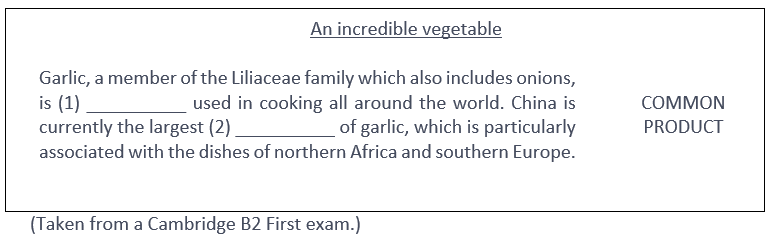
Answers: (1) commonly (2) producer
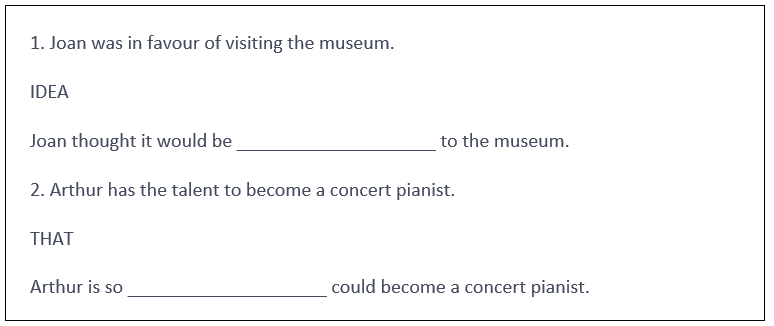
Part four requires students to ‘transform’ sentences, using a given word:
(Taken from a Cambridge B2 First exam.)
Answers: (1) a good idea to go (2) talented that he
The influence that a test has on teaching and learning is known as the ‘backwash’ (or ‘washback’) effect.
In the past, students who knew that they were preparing to take a language exam which included no oral or written component had little interest in improving their speaking or writing skills. Despite their teachers’ best efforts, most students preparing for the original TOEFL exam preferred to spend the majority of their time doing multiple choice questions.
The move from indirect to direct testing has had a positive effect on syllabus design and teaching practices.