
The value of extensive reading
In the classroom, teachers tend to focus on intensive reading, using frameworks similar to the one outlined in the previous section. In general, little attention is given to extensive reading. In real life, avid readers do a lot more extensive reading than intensive reading. People who read for pleasure tend to read long texts quickly, without worrying too much about the details.
Comprehensible Input
Krashen (2004) stated that we acquire language when we understand messages. He emphasized that language learners need to be exposed to what he called ‘comprehensible input.’ Comprehensible input is listening or reading material which can be understood by listeners or readers even though they don’t understand all the vocabulary or grammatical structures that the texts contain.
Since 2004, a great deal of research has been done comparing comprehension-based methods with more traditional methods of language teaching and learning, and the results have been impressive. According to Lightbown and Spada (2013), ‘Comprehensible input remains the foundation of all language acquisition.’
So, not only does reading and listening to comprehensible texts improve students’ reading and listening skills. It actually helps students to acquire grammar and vocabulary – and this in turn has a positive impact on their ability to use language more effectively.
Research has shown that students need to be able to understand a high percentage of the vocabulary, around 95 to 98%, which is perhaps higher than most teachers realize, in order to be able to ready a text ‘easily.’
Let’s consider briefly what that means. Marcos Benevides’ presentation at the 2015 IATEFL conference was entitled “Extensive Reading: Benefits and Implementation.” It included a series of texts which showed the impact that unknown words have on our ability to read a text ‘easily.’
Even when virtually all the words are familiar, the occasional unknown word causes few problems. These texts get increasingly harder to understand when just a few more words are unknown.

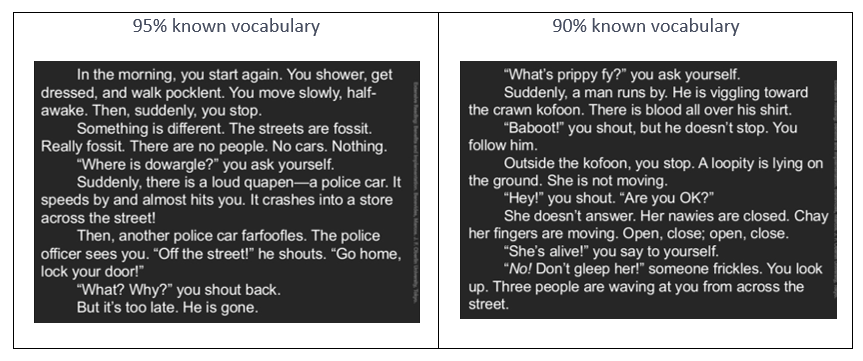
How did you feel when reading with the text on the right-hand side? You could read it, right – but the unknown vocabulary starts to have an impact on your ability to read ‘fluently.’ As Hirsh and Nation (1992) concluded, ‘having to struggle with reading because many words are unknown will take a lot of the pleasure out of reading.’
What should our students read?
A great way to encourage students to read extensively outside the classroom is through the use of ‘graded readers.’ Graded readers are books which are carefully simplified so that they are appropriate for different levels. The main aim of graded readers is to encourage students to read extensively for pleasure.
Many publishers, such as Cambridge, Oxford and Pearson, have a wide variety, designed for young learners, teenagers, and adults. The readers for young learners include a mixture of traditional fairy tales such as Cinderella or Peter Pan, up-to-date stories such as Toy Story or Spiderman, as well as a range of non-fiction titles. Readers for older students include well-known novels or classic movies, as well as biographies of famous people such as Usain Bolt or Barack Obama.
Readers for young learners are usually available at levels ranging from A1 (beginner) to B1 (early intermediate). Adult readers are also available at higher levels such as B2 and C1. These days many graded readers are available as e-books and they often come with an audio version of the written text.
If you are able to get your hands on a set of graded readers, you can make a real difference to the amount of reading your students do outside the classroom. Spend some time introducing your students to the idea and give them time to browse through the titles and find one that interests them.
A wide range of classroom resources is available to support the use of graded readers in the classroom. However, if you truly want to encourage ‘reading for pleasure,’ perhaps consider keeping homework tasks to a minimum and ask them to read something they enjoy.