
What is Reflective Practice and Critical Reflection
What is reflective practice?
Reflective practice is about learning from ordinary and interesting situations and from the issues and problems that are part of educators’ daily experiences. It is a critical examination of not only what happened but why. For example, an educator may reflect on the original objectives and expected outcomes of a plan and consider how they evolved.
It is a way to learn from your experiences and build on what you already know by thinking about and questioning what happened or what you believe. Reflective journal is a tool to help you become a better educator
What is Critical reflection?
Critical reflection involves learning from everyday situations and problems. It means regularly asking questions of yourself and about your actions to better understand why things happened in a certain way and how this might inform future planning and actions. It is central to making changes and improvements to support children’s learning and outcomes. Critical reflection is a form of ongoing learning that encourages educators and staff to:
• Think about their practice and the provision of education and care of their service from different viewpoints;
• Gather information from different perspectives to develop a deeper understanding of their work;
• Make conclusions about the strengths and opportunities for improvement of their practice and the care provided to children;
• Explore ideas for different ways that these activities, interactions, approaches and procedures could happen and different ways that they could
think about them; and
• Identify some quality improvements and a plan for how to integrate these within the program and practice.
It is applied to each aspect of the program – the planning cycle, the principles that guide the NQS, the educator’s own behaviour, activities and interactions, operation of the service and the children’s learning and development. It is essential to program planning and implementation, and should be part of each educator’s daily activities. It helps educators to identify what is working and what needs to be improved or changed.
Analysing a critical incident may help you to:
• “reflect-on-action” (ie past experience),
• “reflect-in-action” (ie as an incident happens), and
• “reflect-for-action” (ie actions you may wish to take in
future experiences)
Why have a reflective journal?
It’s a tool to help you become a better educator. It is also a way to meet the requirements for reflective practice in the Early Years Learning Framework and the National Quality Standards.
Here is a sample reflective journal template for you to write down your reflections. You can download it and print as many pages as you like.
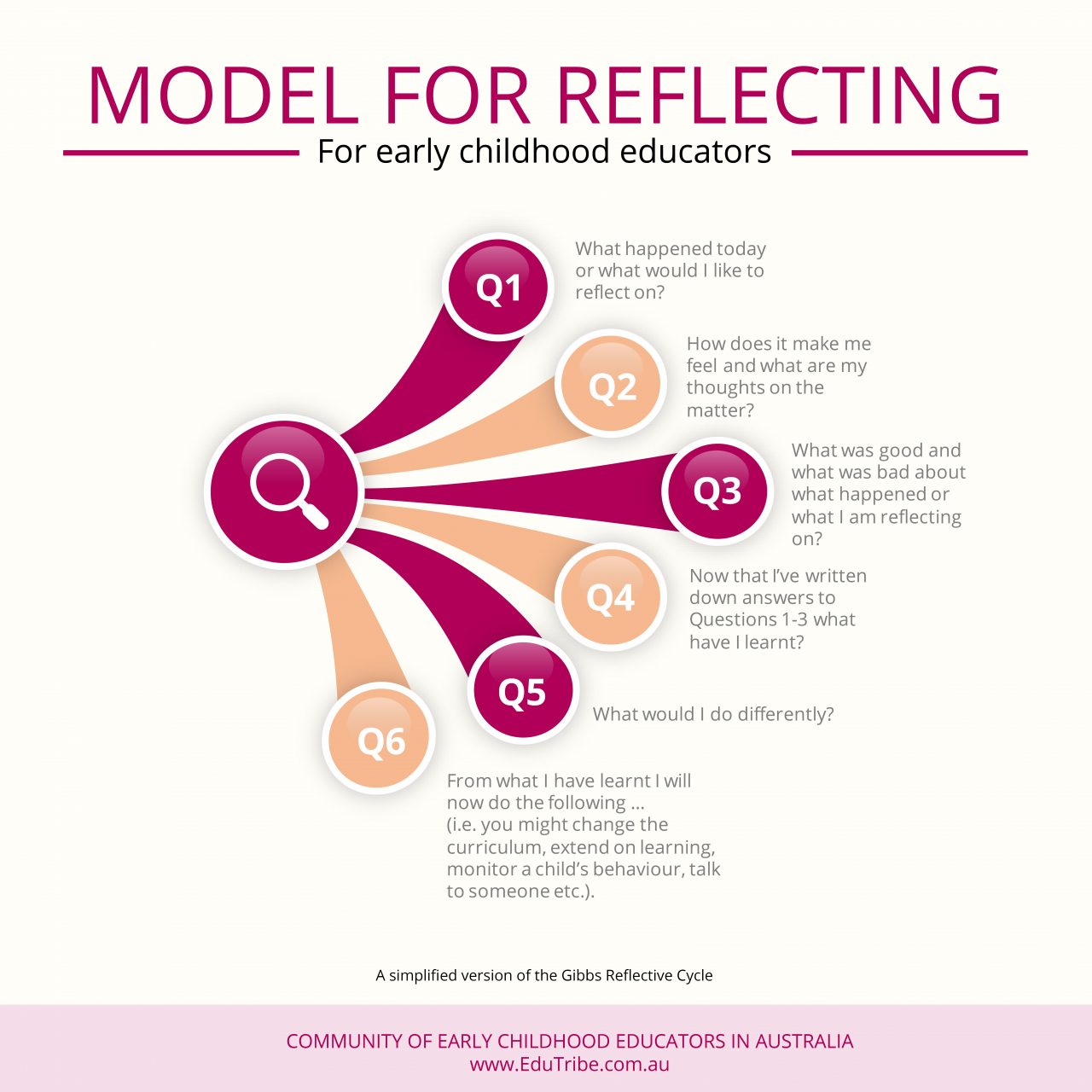
Question 1
What happened today or what would I like to reflect on?
Question 2
How does it make me feel and what are my thoughts on the matter?
Question 3
What was good and what was bad about what happened or what I am reflecting on?
Question 4
Now that I’ve written down answers to Questions 1-3 what have I learnt?
Question 5
What would I do differently?
Question 6
From what I have learnt I will now do the following …
(i.e. you might change the curriculum, extend on learning, monitor a child’s behaviour, talk to someone etc.).
A simple model for reflecting
There are lots of models to show you how to reflect on practice. Gibbs Reflective Cycle is a common one used in early education and care. The diagram below is a simplified version of the model Gibbs developed to help you understand how to reflect on your practice.
Is it best to reflect alone or with others?
Alone is OK but doing it with others is better. This is because you get a lot of different ideas from other people to inform your learning. Consider using this journal with other educators at your centre.
What should I reflect on?
The first level is to reflect on what the children are doing and learning. What is happening with families and the community that influence children’s learning. Culture. Children’s wellbeing and relationships. The curriculum.
The second level is to reflect on what is happening in your room or the centre. Are you working as a team? Are the transitions working well? How are flexible routines working? How does your personal philosophy about working with children fit with the centre’s philosophy or other educators? Teaching strategies and pedagogical philosophies. The centre’s policies and procedures.
The third level is to reflect on what is happening in the industry and even the world that could impact on the work you do or children’s learning. This could come from changes in government policy related to early education and care or big events that children become aware of.
Choose one of the simple questions below to get started right now and conquer that critical reflection fear!
- What are you confident is working well in your day to day practice?
- What have you identified isn’t working well for you?
- What might you consider changing?
- How could you find out more about something to make it work better?
- In what areas would you like to grow more as an educator?
These questions from the Australian Early Years Learning Framework are also very helpful to begin and guide reflection (although obviously more in depth):
- Who is disadvantaged when I work in this way? Who is advantaged?
- What are my understandings of each child?
- What theories, philosophies and understandings shape and assist my work?
- What aspects of my work are not helped by the theories and guidance that I usually draw on
to make sense of what I do? - What questions do I have about my work?
- What am I challenged by? What am I curious about? What am I confronted by?
- Are there other theories or knowledge that could help me to understand better what I have observed or experienced? What are they?
Some more ideas on what things you could reflect on?
1. What you feel/think the children are learning from observing them. This could be individual or groups of children or the room.
2. How you are deciding on what the children are interested in.
3. How you are listening to children’s ideas, and what you will do with them.
4. How you work with children with additional needs.
5. How you plan the curriculum and how it is working.
6. How you are including culturally diverse families and cultures at your centre.
7. How are you building on children’s learning?
8. How you document and link children’s learning to create a cycle of planning.
9. How you engage with families.
10. How you engage with the community.
11. How you respond to feedback you have received from families or your manager.
12. How you use your professional knowledge (including your knowledge of the children and their families) to inform your practice.
13. How your philosophy fits with the centre philosophy.
14. How your room or the centre is working as a team.
15. How you are using educational models in your teaching.
16. Something you have learned through reading or attending training.
Sample Reflections


RESOURCES
Here are some other resources that you may find
useful on deadly reflections.
- The NQF guide – explains deadly reflection and its
role in the NQF. It also has great questions to guide
reflection on each standard and element of the
NQF. - Developing a Culture of Learning Through
Reflective Practice: National Quality Standard
Information Sheet, ACECQA. - Uncovering the layers of reflective practice,
ACECQA. - Fact Sheet – EYLF Principle 5: Ongoing learning
and reflective practice, SNAICC. - The empowered educator blog – with reflection
learning action guide. - The ACECQA Blog, which has posts about
key issues all involving deadly reflection.
This includes a post on reflecting on how you
respect and value Aboriginal and Torres Strait
Islander cultures in the development of a
Reconciliation Action Plan. - Foundation for Success has some amazing videos
on a whole range of activities and areas of practice,
with insights from Aboriginal and Torres Strait
Islander leaders in Queensland. This includes a
video on documenting and reflecting. - critical_reflection_fdc_version.pdf (holisticapproachfdc.com)https://www.holisticapproachfdc.com/uploads/5/0/7/2/50727587/critical_reflection_fdc_version.pdf