
Improving students’ writing skills
Freer written practice, which is also known as guided writing, helps to bridge the gap between controlled written practice of language and writing as a skill. Well-designed guided writing tasks give students to use the target language together with any other English they know.
Guided writing often involves using an example text as a ‘model.’ The teacher usually sets some comprehension tasks first, to check students’ understanding of the model text, and then moves on to focusing on useful language and preparing students for the task. This ‘product approach’ as it is sometimes known, works well with lower level students or with students who need to learn how to write a particular type of text, such as an informal email.
In many ESL classrooms, teachers approach writing skills in the following way:
Step One – set writing task
Step Two – collect writing task
Step Three – mark writing task
Perhaps it is not surprising that students are sometimes less than enthusiastic when it comes to writing tasks..!
To help our students to become better writers, we need to involve them in the process of writing. In the ‘real world’, this typically includes brainstorming ideas, planning what we are going to write (for example, by selecting, rejecting and ordering ideas), writing a first draft, reviewing and editing it, then writing a second draft…
‘Process writing’ as it is known, is a much more realistic approach. Although it is a lot more time-consuming, students’ motivation levels are usually considerably higher once they understand how it works, and the results can be impressive.
Just as with speaking skills lessons, try to choose topics which are meaningful to your students. Only students who are planning to visit an English-speaking country are likely to see the relevance of writing an email to a homestay family in the UK. Instead, perhaps they could write a review about a product they bought online – or an email complaining about an experience at a local restaurant.
As with speaking skills lessons, the final stages of a process writing lesson involve feedback on content and feedback on language. Where possible, it’s a great idea to give students the opportunity to share what they have written with their classmates. Perhaps you could prepare a feedback form to encourage students to comment on both the content and the use of language in their colleagues’ work (a similar idea could also be used during the reviewing / editing stages).
Correcting students’ written work
Students generally expect their teachers to read, correct and then grade their written work. Many institutions have a policy on the way students’ written work should be corrected and graded, but if not, you may have some decisions to make.
Option 1 – You could cross out mistakes with a red pen and write a score or grade at the bottom of the page:

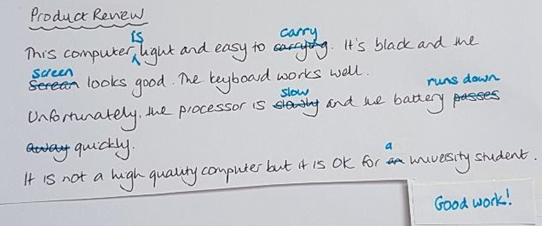
Option 2 – You could correct mistakes using a different color and write a brief comment at the bottom of the page:
Option 3 – You could use a ‘correction code’ together with a comment at the bottom of the page.
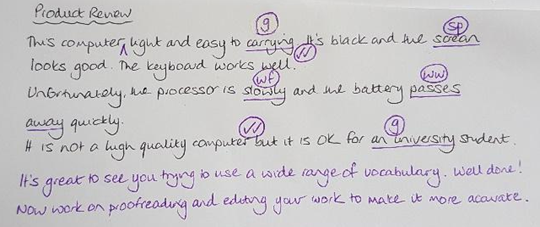
This idea is similar to the ‘correction slot’ we saw at the end of the speaking skills lesson, in which students had the opportunity to correct their own mistakes. Different symbols are used to show the different types of mistakes that the students have made – as well as examples of language used correctly.
Clearly the code can be used at the teacher’s discretion. If a student has attempted to use a complicated piece of language and is unlikely to be able to self-correct the mistake, the teacher has the option of simply writing in the correction.
Many teachers have their own variations of this correction code, and they make sure that their students understand the symbols at the start of a new course. In this example:
^ = word missing
g = grammar
sp = spelling,
✔✔ = Well done!
wf = word form, ww – wrong word
What are the pros and cons of each approach? If you were a student, which method would you prefer your teacher to use – or would you prefer a combination?
However you decide to correct your students’ written work, it’s important to achieve a balance between positive points and points to work on.