
Production of speech
Sounds for speech are produced by a combination of organs in the vocal tract. Speech production is a complex process. All the essential speech sounds in English are made by air from the lungs passing through either closed or open vocal cords (which are found in the larynx) and shaped by various articulators and resonating cavities.
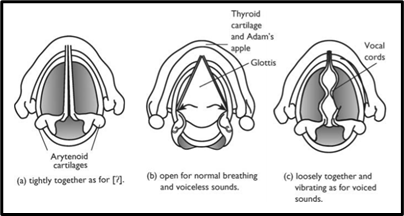
Sounds that come through open vocal cords are called ‘unvoiced’ sounds. In these sounds, there is a gap between the vocal cords. This gap between the vocal cords is called the ‘glottis’. Sounds that use closed vocal cords are called ‘voiced’ sounds. For example, / s / is unvoiced and / z / is its voiced equivalent. To check whether a sound is voiced or unvoiced, fingers are placed on the front of the throat while making the sound. If there is a vibration, the sound is considered voiced. Consonants can be voiced or unvoiced, and all but two of the consonants (/ w / and / j /) involve a blockage or restriction of air to make its sound. Vowels are always voiced.
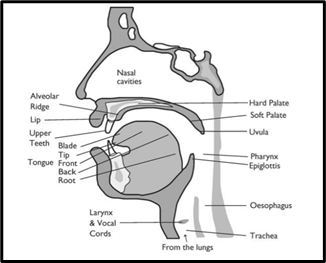
The articulators include the lips, teeth, alveolar ridge, hard and soft palates, glottis and, of course, the tongue. The tongue is the most versatile articulator and it is essential to creating speech sounds. The back, center, front, blade, tip, root and even the sides (rims) of the tongue are used to articulate speech sounds. The resonating areas of the pharyngeal (back of the throat), oral (mouth) and nasal (nose) cavities further modify speech sounds. Students are often unaware of how they make vocal sounds, even in their first language. Building awareness in how speech sounds are produced helps students gain better control over their pronunciation.