
Rewards and consequences
In addition to praising students, many teachers use a reward system as a way of reinforcing positive behavior in their classrooms. As with other aspects of classroom management, it is important to establish how the reward system works when you start teaching a new class.
Some teachers reward individual students who are well-behaved, whereas others focus more on the behavior of the class as a whole. Teachers who reward examples of good behavior by individuals often use simple star or sticker charts. These are easy to make and can look like this:
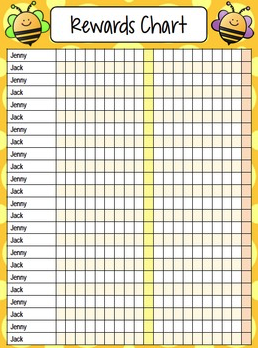
In this example, the teacher writes all the students’ names down the left-hand side. Then whenever a child meets a certain objective, or perhaps makes good progress with a weaker area, he or she is awarded a star, which is then added to the chart. As mentioned previously, research has shown the importance of making it clear exactly why the student received the star.
In most classrooms, when a student collects a certain number of stars, they will be able to choose a reward, such as receiving a special certificate of achievement or having lunch with the teacher. Studies show that when they are implemented effectively, star charts can motivate students to improve their behavior.
In some countries ‘clip charts’ are traditionally used to track and display whether a student’s behavior is ‘acceptable’ or not. The difference here is that no reward is offered to well-behaved students. Recent research found the system to be ineffective in terms of improving the way most students behave. Even students whose behavior was consistently good were found to be more distracted and less engaged when this type of system was implemented (McIntosh, 2020).
One popular system for rewarding positive group behavior is a marble jar.
Students can ‘earn’ marbles as a class. For example, by following instructions or working well together on an activity. Each time the class earns a marble, the teacher puts it in a jar and the class moves one step closer to receiving a class reward, such as extra game time or perhaps even a field trip.
Teachers who favor this kind of ‘whole class’ reward system often comment that it encourages students to motivate and support each other, as individual behavior has a direct impact on the whole class.
Sometimes, despite teachers’ best efforts, negative behaviors persist. In these cases, further consequences are needed. A consequence is the reaction of the teacher that comes after an action. In a classroom, consequences are meant to teach, hold students accountable for their actions and maintain safety. Just like rules and reward systems, these need to be established from the outset.
Here is an example of list consequences teachers could develop for their classroom to get students back on track and promote learning. These consequences can be implemented in order. In many cases, the first consequence will be effective.
- Private conversation with teacher
- Removal of privileges
- Phone call to parents
- Meeting with parents
Consequences should not be confused with punishment which is intended to impose authority, shame or harm. Punishment often comes from a need to maintain control instead of seeing the action as a teachable moment. Some researchers suggest that punishing children teaches them that inflicting pain or shame is an acceptable reaction to perceived negative behavior in some situations (Hoy & Weinstein, 2006). Other studies indicate that teaching appropriate behavior is more effective than trying to control it in terms of long-term student success (Manisha, 2019).
Trial and Error
Classroom management strategies that are effective with some students or classes may not work as well with others. The use of these strategies often involves some trial and error. Finding out what works with students can take time and patience. Perhaps the most important element of your classroom management approach is that your students understand that classroom expectations are crucial to allowing them to learn.